
Overview
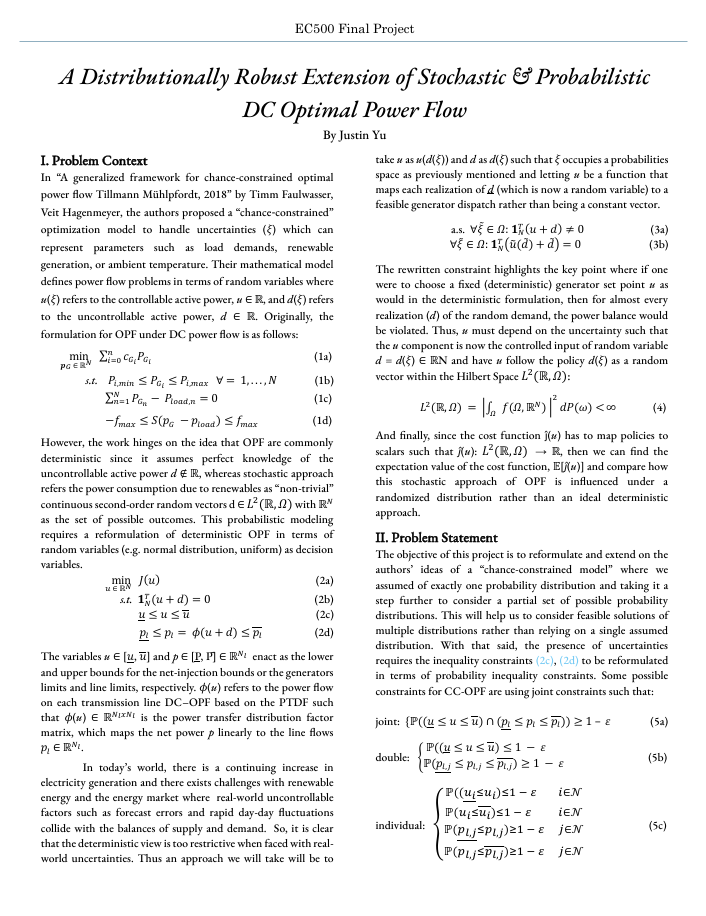
This paper explores chance-constrained DC Optimal Power Flow (DC-OPF) under uncertain load demand. Rather than assuming the uncertainty is Gaussian, I studied multiple distributions and built deterministic convex reformulations that still guarantee probabilistic reliability on generator limits and line flows.
Problem
Real demand uncertainty is often bounded or skewed. Gaussian assumptions can underestimate tail risk or misrepresent feasibility when constraints are tight.
Approach
Use Polynomial Chaos Expansion (PCE) with distribution-matched bases (e.g., Legendre for Uniform, Laguerre for Gamma) plus chance constraints to obtain deterministic convex programs.
Methods
The workflow combines uncertainty modeling, PCE coefficient propagation, and a convex optimization layer. A key idea is representing uncertain quantities with orthogonal polynomial bases so constraint probabilities can be bounded or converted into deterministic inequalities.
Uncertainty modeling
• Load modeled as random variable(s) across different distributions
• Canonical / non-canonical PCE depending on the uncertainty family
• Coefficient interpretation: mean/variance and higher-order behavior
Optimization layer
• Chance constraints on generation and line flows
• Deterministic reformulations (moment/CDF based depending on distribution)
• Solved as convex program (SOCP-style constraints in CVX)
Results
Comparing distributions highlights how “risk” changes operational cost and constraint activity. Stricter chance constraints (smaller ε) push solutions toward safer dispatch and may introduce feasibility cliffs depending on uncertainty magnitude and network congestion.
Key observations
• Risk parameter ε trades off cost vs reliability
• Bounded/skewed uncertainty can shift constraint activation patterns
• Larger uncertainty can create infeasibility or sharp cost increases
Tools used
• MATLAB for modeling + experiments
• CVX for convex optimization
• PCE basis matching (Legendre / Laguerre)
Final Paper
You can scroll the PDF directly below. If your browser blocks embedded PDFs, use the “Open PDF” button.
Reflection
Challenges
• Translating probabilistic constraints into usable deterministic forms
• Debugging feasibility issues when ε became too strict
• Matching PCE bases to uncertainty families and validating assumptions
• Keeping the pipeline stable as uncertainty magnitude increased
What I learned
• How chance constraints shape dispatch decisions under uncertainty
• How PCE coefficients map to moments and constraint conservatism
• Convex modeling discipline: “make it solvable” without losing meaning
• Stronger intuition for OPF constraints and congestion behavior
 by Justin Yu